Your products, ready for Japan.
I help overseas technical manufacturers sell in Japan with bilingual product data, Japanese materials, and lead follow-up that stay accurate and consistent, whether you sell through distributors, your website, or trade shows.
From updating your Japanese content when the English changes, to trade show materials and day-to-day marketing, I work as the hands-on partner between your headquarters and the Japanese market.
Get a free content checkWhere Japan launches usually stall.
Three names for one product.
Your distributor translated your product names their own way, and now your catalog, website, and quotes all use different versions.
Pages that read like a machine wrote them.
The meaning comes through, but Japanese engineers and buyers find them hard to read and harder to trust.
A trade show in six weeks.
Your booth is booked, and your materials are still English only.
200 business cards, no follow-up.
You came back with a stack of contacts, and no thank-you emails or follow-up went out in Japanese.
I help solve these by organizing your product data, unifying your Japanese terminology, and setting up follow-up that keeps running after every inquiry. See services
One system for selling in Japan, from product data to follow-up.
Most teams fix Japan one piece at a time: a translated brochure here, a distributor sheet there. I build the foundation once and keep it running, so every page, catalog, and email says the same thing in the right Japanese.
- Product dataOne bilingual source
- Pages & catalogsWebsite, CMS, distributors
- Trade showsJapanese materials on time
- Leads & follow-upCRM and Japanese emails
Japan Content Check
Send me one product page, catalog, or distributor sheet. Within 3 business days, you get a short report on what Japanese buyers may misread, what sounds like machine translation, and what to fix first. The first page is free. A full review of your site and sales materials is available as a paid follow-up.
- Inconsistent terminology and product names
- Tone and clarity issues from a Japanese B2B buyer’s point of view
- A prioritized list of fixes
Bilingual Product Data Foundation
I turn scattered catalogs, spec sheets, and spreadsheets into one bilingual product database, with consistent names, terms, and units, reviewed Japanese for every product, and a simple admin screen your team can use to update it. The same data feeds your website, a searchable catalog, and your distributor materials.
- Product data cleanup, consolidation, and import
- Japanese–English glossary and style rules
- Admin screen and searchable product catalog
- Data export for your CMS, distributors, and print
Japan Market Operations
A monthly partner for the work that never stops: adding new products, preparing for trade shows, and following up on the leads those shows bring in. Before each show, your flyers, product pages, and invitations are ready in Japanese. After the show, your contacts are organized in your CRM and receive follow-up emails written with Japanese business customs in mind.
- Product data updates and maintenance
- Japanese materials and content before each show
- Lead cleanup, plus Japanese follow-up emails written and sent
- Hands-on support in tools like Zoho and Pardot
Selected examples.
Most client projects are covered by NDAs, so these are illustrative samples that show how I work, using fictional company, product, and event names.
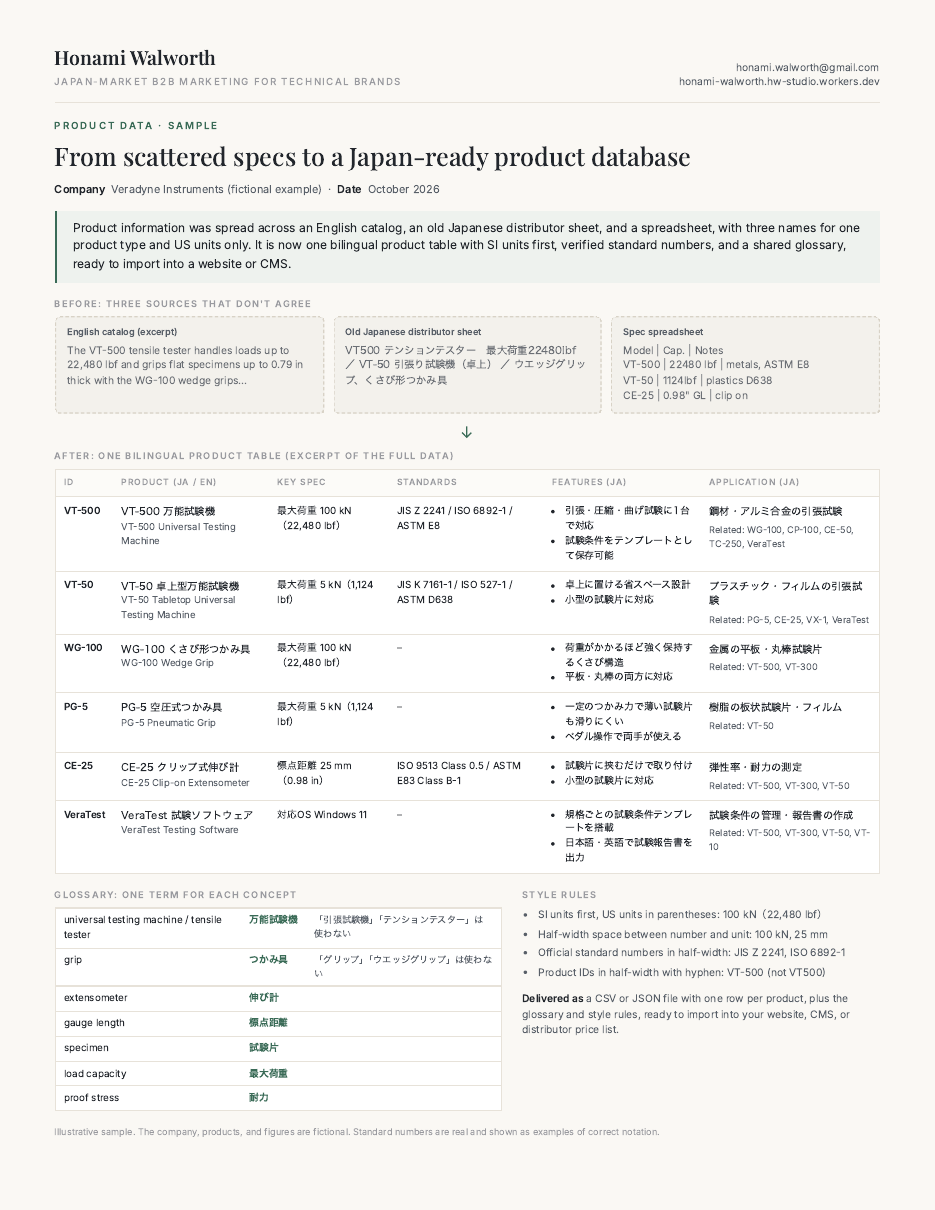
From scattered specs to a Japan-ready product database
For a fictional manufacturer, product details spread across an English catalog, existing Japanese materials, and a spec spreadsheet were consolidated into one bilingual product dataset.
Product names and technical terms are unified, and units and standard numbers follow one set of rules. The same data then powers a demo website where you can search products in Japanese or English.
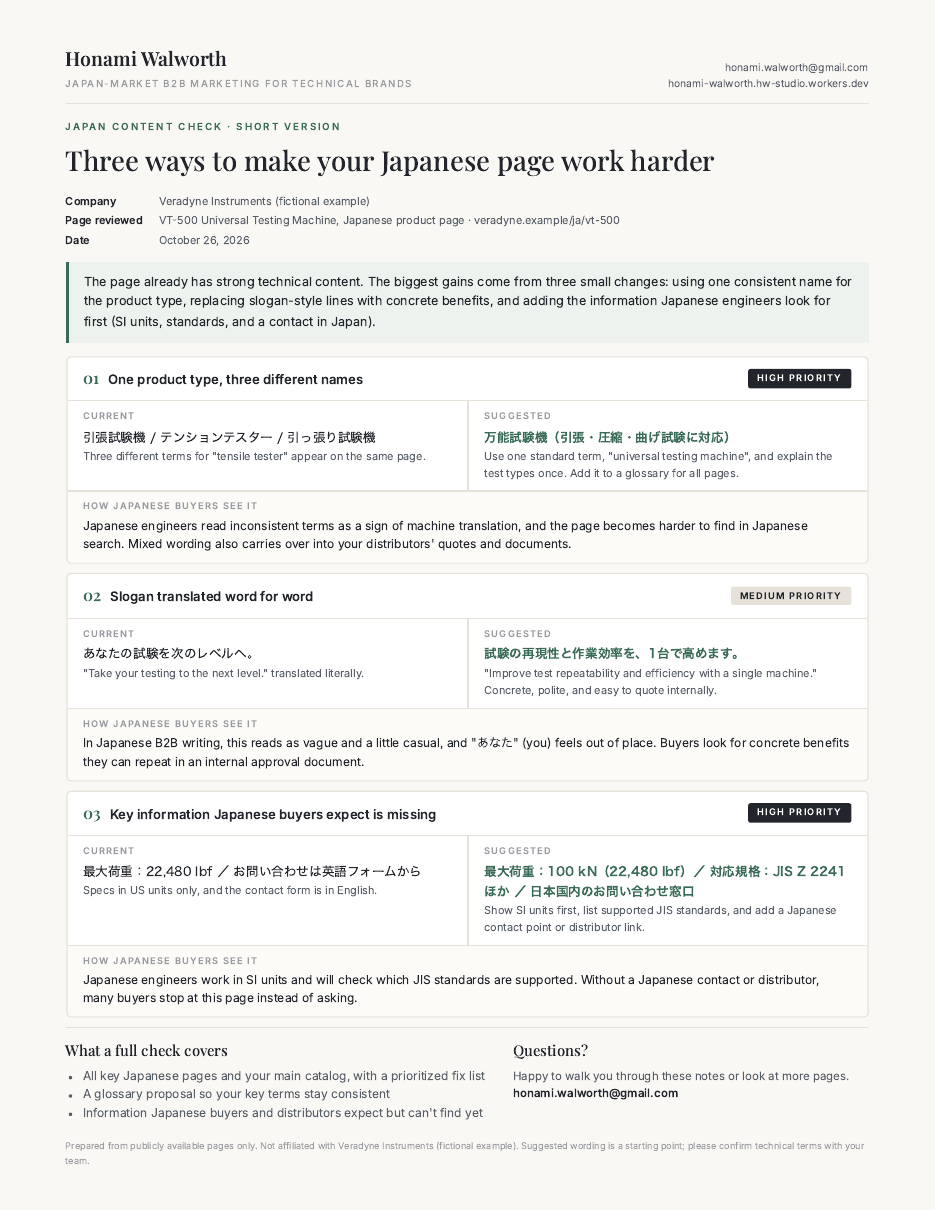
What a free check looks like
A sample report for a fictional company, showing where its Japanese content could improve.
Each issue comes with suggested Japanese and a plain-English explanation your headquarters team can review. Not just what is wrong, but how to fix it.
Your free check comes in this same format.
View the sample (PDF)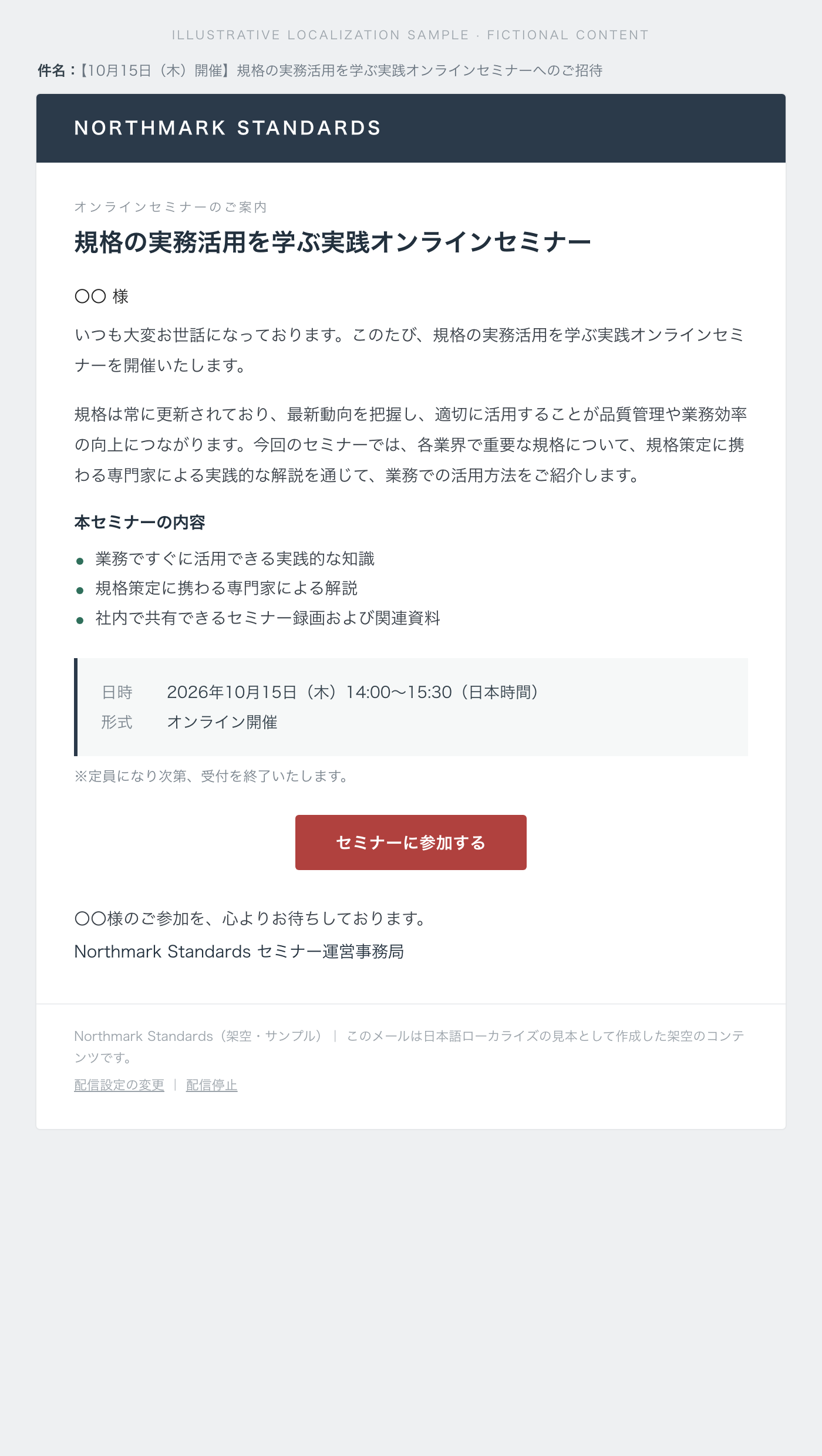
A webinar invitation written for Japanese readers
A sample webinar invitation created for sending in Japanese, from the subject line and event details to the registration button.
Rather than translating the English word for word, the tone, structure, and path to sign-up are designed for Japanese readers.
Trade show invitations and post-inquiry follow-up emails are created and sent the same way.
12+ years connecting overseas manufacturers with the Japanese market.
For over twelve years, I've supported Japan-market marketing for overseas industrial and manufacturing brands, both as an in-house marketer and as an outside partner.
The work spans product catalogs and web pages, trade show preparation, and email marketing to a database of approximately 30,000 leads. Beyond content, I've planned and run campaigns, and set up and administered a 100-user Salesforce and Pardot rollout.
More recently, I've been consolidating scattered product information from catalogs and spreadsheets, designing bilingual product databases and style rules, and migrating data into CMS and CRM platforms.
Because client work is confidential, I describe projects in general terms and let the samples show the quality.
My focus is helping overseas manufacturers sell in Japan, from accurate product data to timely follow-up, with work that keeps running long after launch.
Built for Japanese buyers. Designed for business.
Native cultural judgment
I adapt language, tone, and messaging to match how Japanese buyers think, evaluate, and make decisions, not just how they read.
I know what distributors need
I've worked on the Japan side of overseas brands for years, so I know what Japanese distributors and buyers need to move a deal forward: the right documents, the right level of detail, and the right tone.
One source of truth
Your product data, glossary, and style rules are managed in one place, so names, terms, and tone stay consistent across every page, catalog, and email, even as your product line grows.
From a free check to the right next step.
I start by reviewing one page of your existing Japanese content and suggesting what to improve. From there, you decide whether to move on to specific production or ongoing support.
Send one page
A product page, catalog, or brochure you would like to improve. A link or PDF is fine.
Get a short report
Up to three priority fixes, drawn from unnatural phrasing, inconsistent terms, or missing information. Each comes with suggested Japanese and an English explanation your headquarters team can review. Usually within 3 business days.
Decide what's next
Based on the results, we can talk about revising existing content, producing new materials, or ongoing marketing support, sized to your needs and budget. The report is yours to use internally either way, with no commitment to a contract.
Good to know.
Can you sign an NDA?
Yes. I'm happy to sign yours before you share anything confidential.
What about the time difference?
I work on US Pacific time and can also meet during Japanese business hours when needed.
Let's talk about your product information and marketing for Japan.
Start by sending me one page of your existing website or product materials. I'll do a free short check and suggest what to improve.
From bilingual product data to ongoing marketing support, including trade shows and inquiry follow-up, I can help with whatever you need. You can start with just the check, just the product data, or any scope that fits.